

How to Write about the Writer’s Purpose (or the Big Ideas of a text): Guide and Examples
What are the Big Ideas?
When you’re writing about literature, you need to be able to articulate the writer’s purpose: why they have written the text and what they are hoping to achieve from it. This will help you to elevate your response. Regardless of whether you’re writing an IGCSE, A-Level or IB response, examiners will want to see you making perceptive links between the writer’s context, intentions and the text.
A theme tells you what the text explores. A big idea combines this with the writer’s intentions: it explains what the writer is trying to say about that theme. A strong big idea usually combines the writer’s name, an analytical verb and a thematic statement about the text.
It links the writer’s themes with what they are intending to do with each of those themes. A strong big idea usually combines the writer’s name, an analytical verb and a thematic statement about the text.
How do you write about the Big Ideas?
An easy way to think about the big ideas is: What are the themes + What is the writer trying to do
Theme: prejudice
↓
What the writer says about it: prejudice can lead to the villainisation of minorities
↓
Writer's purpose: Lee warns readers about the consequences of this.
Big Idea Statement: Lee is warning readers about the consequences of prejudicial thinking and villianising minorities within society.
Analytical Verbs
Analytical verbs are your best friend to articulate these ideas. They help you to analytically comment on what the writer is doing — and why they have done that.
Examples of really useful analytical verbs for the big ideas include:
warn - to tell somebody about something, especially something dangerous or unpleasant that is likely to happen, so that they can avoid it
teach/educate - to help somebody understand something by giving information about it (be careful with oversimplifying this!)
expose/reveal - to show something that is usually hidden
condemn - to say that you think something is really bad, usually for moral reasons
celebrate - to praise someone/something
Using Evaluative Adverbs
It can be great to combine these words with a well chosen evaluative adverb, too. This will elevate your answer and show that you’re being critical about HOW the writer is doing something AND WHY they’ve done it.
These pairings work really well:
carefully warns
forcefully condemns
subtly exposes
celebrates
powerfully challenges
Combine your analytical verbs with a statement about what the text is saying about society. It’s really important that you avoid the obvious interpretations, here, and to consider what you know about how the writer’s context influenced their writing.
Choosing the Right Analytical Verb
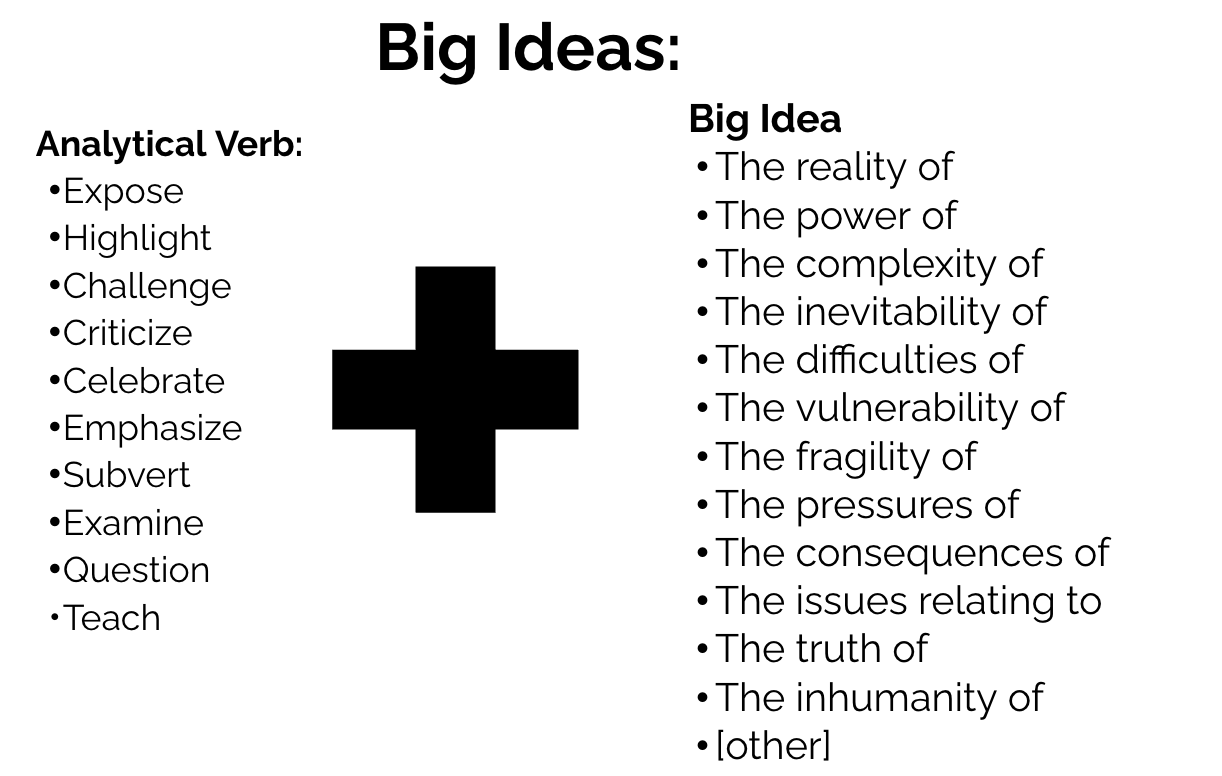
The structure below can be really helpful for articulating your ideas in an analytical style, but make sure that the analytical verb you pick matches your interpretation.You can’t just randomly select an analytical verb from the list. It needs to accurately reflect what the writer is doing. Otherwise, you’ll end up with wildly inaccurate statements like:
Shakespeare is celebrating the pressures faced on female leaders or Lee is celebrating the harsh reality of a prejudicial society.
Examples of Big Ideas (whole text)
Before you start writing, just brain dump ideas for the whole text using: analytical verb + theme = Big Idea
And then refine those into proper sentences, using evaluative language to make your ideas more precise and refined (like below)
Big Ideas - Things Fall Apart:
Achebe may have written Things Fall Apart to:
warn → masculinity → warn about the consequences of having a binary view of masculinity
teach → Igbo culture → teach Western readers about the complexity and heterogeneity of Igbo society
challenge → reductive stereotypes → challenge the reductive colonial stereotype that African societies were primitive and barbaric
Achebe wrote Things Fall Apart to warn readers about the disastrous consequences of having a binary view of masculinity
Through his text, Achebe teaches readers, particularly Western readers, about the complexity and heterogeneity of Igbo society, challenging reductive representations of African cultures that emerged through colonialism.
Achebe uses Things Fall Apart to challenge the reductive colonial stereotype that African societies were primitive and barbaric and therefore needed to be “saved” through colonialism.
Big Ideas - To Kill A Mockingbird:
Atwood may have written To Kill A Mockingbird to:
expose → prejudice → expose how racial prejudice can distort people's understanding of justice and morality.
teach → empathy → teach readers about the importance of empathy in challenging prejudice and understanding perspectives different from our own.
warn → complacency → warn readers about the consequences of remaining passive in the face of injustice.
Lee wrote To Kill a Mockingbird to expose how racial prejudice can distort people's understanding of justice and morality.
Through her text, Lee teaches readers about the importance of empathy in challenging prejudice and understanding perspectives different from their own.
Lee warns readers about the consequences of remaining complacent in the face of injustice
Lee celebrates the power of individuals in challenging systemic and societal prejudice
Big Ideas - The Handmaid’s Tale:
Atwood may have written The Handmaid's Tale to:
expose → oppression → expose how systems of power can control and suppress women through the regulation of their bodies and identities.
condemn → misogyny → condemn the normalisation of misogynistic attitudes and the unequal distribution of power between men and women.
warn → complacency → warn readers about the dangers of becoming complacent when individual freedoms and rights are gradually eroded.
Atwood wrote The Handmaid's Tale to expose how systems of power can control and suppress women through the regulation of their bodies and identities.
Through her dystopian society, Atwood condemns the normalisation of misogynistic attitudes and the unequal distribution of power between men and women.
Atwood warns readers about the dangers of becoming complacent when individual freedoms and rights are gradually eroded.
What about Drama and Poetry?
The examples in this post focus on novels, but the same approach can be applied to drama and poetry. You can still think about what the writer is trying to say about a theme and why they have chosen to present it in this way.
I'll explore how to develop Big Ideas for drama and poetry in the next post.
How do I apply this to an exam question?
After the drama and poetry series, the following blog post series will cover how to apply this to an extract question and how to apply this to a whole text question.
